Private
Roundwise
AI mock interviewer for live voice or text rounds, with adaptive questioning, rubric scoring computed in code, and speech analytics.
Python / FastAPI / LangGraph / WebSockets / Flutter / Claude
How the interview decides what to ask next
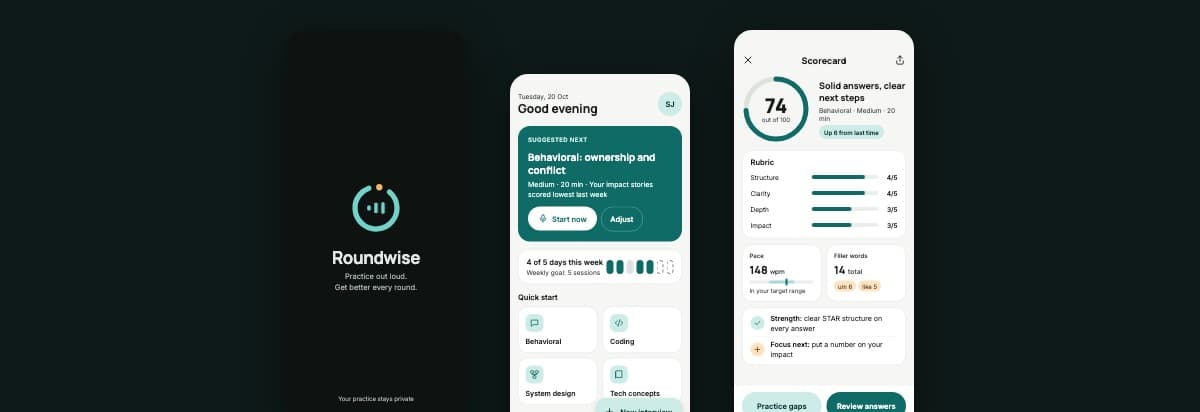
Roundwise runs live mock interviews by voice or text. A LangGraph engine plans the topics, asks each question and waits at an interrupt for the answer, checkpointing to Postgres after every step so a session survives reconnects and server restarts. The model supplies signals and code makes the decisions: a quick assessment of each answer feeds a plain Python function that weighs time left, follow-up caps and topic coverage, so an answer that tries to steer the interview cannot change its course.
How a voice turn works and survives a dropped connection
In voice mode, microphone audio streams over a WebSocket to Deepgram for live captions, word timings and filler words. The candidate taps Done to end an answer, because interview answers contain long thinking pauses that endpointing would cut off, and pace is measured with pauses of two seconds or more taken out. Each question is spoken with ElevenLabs a sentence at a time as it streams, and every early sentence is first checked for leaks of the private interview plan.
If the connection drops, the server replays missed events from a Redis buffer, or sends a snapshot when the gap is too large, and keeps a half-spoken answer for the candidate to continue.
How answers are scored
The model grades five rubric dimensions from 1 to 5 against written anchors; the 0 to 100 answer and overall scores are computed in code with weights for each interview type, minus 5 points per hint. A strong model writes questions and grades answers, a fast one handles quick assessments, hints and summaries, and a per-session cost ceiling moves questions to the fast model. Every model call has a deterministic fallback, so an outage lowers question quality without stalling the interview.
How code, resumes and releases are checked
A coding round provides starter code in six languages and reviews submissions for complexity, bugs and missed edge cases without running them. Resumes are typed by magic bytes, parsed behind zip-bomb and XML-entity guards, and reach interview prompts only as a capped, structured profile wrapped as untrusted input. The stack is FastAPI, Postgres, Redis and Flutter, with CI covering ruff, mypy, import layering, a migration round trip, API and WebSocket contract validation, and gitleaks.